
Business Website Creation: A Guide for Small and Medium Businesses
Business website creation is not reserved for large corporations: it is a growth lever available to any company, whatever its size or sector. This guide walks you through each step: defining your goals, choosing the type of site, domain name, content, SEO basics and long-term maintenance.
Why Create a Business Website?
A website improves your company's visibility and strengthens its professional image with your customers, partners and future employees. When it is well designed, it helps generate leads and build customer loyalty.
The main benefits of a business website:
- Customer acquisition: a site that ranks well lets qualified visitors find you at any time.
- Credibility: a professional design, authentic customer testimonials and examples of past work build trust.
- Recruitment: showcasing your company culture, your values and your job openings attracts talent.
- Customer service: bringing together an FAQ, order tracking or support improves the user experience.
- Brand protection: an official website and a well-chosen domain name reduce the risk of confusion or impersonation.
A few examples of use cases:
- A restaurant can display its menu online and take reservations.
- A B2B consulting firm presents its expertise and past projects to generate quote requests.
- A shop can sell online, locally or internationally, through a multilingual e-commerce site with online payment.
Website creation can be handled in-house or entrusted to a specialized partner such as UnzipTech, depending on your resources and your pace.
Clarify Your Goals Before Creating a Website
Before thinking about design or code, ask yourself the fundamental question: what do you expect from this site? A good website is built on clearly defined business goals.
Possible goals:
- Generate online quote requests
- Take bookings or appointments
- Sell products through an online store
- Recruit new employees
- Inform your partners, suppliers or investors
Phrase each goal in a precise and measurable way (the SMART method): what you want to achieve, how you will measure it and by when.
Depending on your main goal, the type of site differs:
- Showcase website: credibility, presenting your business, lead generation
- E-commerce website: selling products or services with a catalog, cart and online payment
- Event microsite: product launch, trade show, one-off campaign
- Customer portal: a secure area for your customers (tracking, documents, support)
- Expert blog: regular articles to demonstrate your know-how and improve SEO
Before launching the project, write a short specification summarizing your goals, your target audiences, your budget and your timeline. This document will make discussions with your team or your provider easier.
Define Your Target Audiences and Customer Journeys (B2B / B2C)
Identifying your target audience precisely is essential for creating relevant content and steering the whole project.
How to identify your target audiences:
- Geographic area: Morocco, Europe, Africa or other markets
- Language: French, Arabic, English depending on the markets you target
- Sector: tourism, industry, services, real estate…
- Type of customer: individuals, SMEs, key accounts
- Specific needs: speed, social proof, online support, easy payment
Build a persona for each priority audience, for example a purchasing manager looking for a reliable supplier with an online catalog, or a traveler who pays close attention to photos, location and customer reviews.
A typical visitor journey: arrival from a search engine or social media → browsing the key pages (Home, Services, Portfolio) → reading testimonials → clicking a call to action (request a quote, book, buy).
Adapt your messages, visuals and calls to action to each persona: for a B2B profile, emphasize the value you deliver and your reliability; for a B2C profile, focus on aesthetics and simplicity.
Choose the Right Type of Site: Showcase, E-commerce or Business Platform
The choice of site type shapes the entire project.
Business showcase website:
- Typical pages: Home, Services, About, Portfolio, Blog, Contact
- Ideal for firms, consultants, craftspeople and service providers
- Goal: credibility and lead generation
Online store / e-commerce website:
- Product catalog, cart, online payment, delivery tracking
- Suited to retailers, brands and craftspeople who want to sell locally or for export
Business platforms or SaaS:
- Solutions built around a specific line of business, with several types of users and a complete back office
- The natural evolution of a simple website into a true business tool
On the technical side, you can start from a standard solution or opt for custom development when your needs are specific. Start with a simple showcase website if your company is just starting out or testing its offer; consider an e-commerce site or a custom web application right away if your market is identified and your model requires advanced features.
Domain Name: Choosing Your Company's Web Address
The domain name is the first thing your customers see and remember. It should be short and related to your business.
Tips for choosing it well:
- Simplicity: easy to spell, pronounce and remember
- Brand alignment: it reflects your company name or your sector
- Suitable extension: a local extension such as .ma for a presence in Morocco, a generic extension for international reach
- Protection: register close variants to avoid confusion
- Professional email: use addresses such as contact@your-domain to build trust
Web Hosting, Security and Performance
Hosting is the technical foundation of your site: it affects availability, loading speed and security. A slow site drives visitors away.
Points to check:
- Performance: response time, image optimization, lazy loading. A small site does not have the same needs as a high-traffic platform.
- Availability: choose a reliable hosting provider.
- Backups: regular backups of the code and the database.
- Server location: a server close to your users reduces latency.
- Technical support: responsiveness and a suitable language of communication.
- Security: SSL certificate (HTTPS), regular updates, protection of forms and online payments. To go further, read our web security best practices.

Design Your Site Structure and Key Pages
The site structure is what guides your visitors from one page to the next. It should be logical and intuitive.
Key principles:
- Keep navigation simple, with few levels (main menu and subpages)
- Make important pages quickly accessible from the home page
Typical structure for a small or medium business:
- Home
- Services / Products
- Industries
- Portfolio
- About
- FAQ
- Blog / News
- Contact
Typical structure for an online store:
- Home
- Shop (categories and subcategories)
- Promotions
- Terms of sale, delivery and returns
- Order tracking
- Help / Support
A clear structure improves both the user experience and the work of search engines, which discover and index your pages more effectively.
Effective Content: Copy, Visuals and Calls to Action
Content should answer visitors' questions and talk about the benefits for them, not only about the company.
Best practices for copy:
- Talk about concrete benefits for the customer: time saved, peace of mind, quality of service
- Adopt a professional and approachable tone, in French and, depending on your audiences, in English or Arabic
- Use short paragraphs, clear headings and bulleted lists
Visuals:
- Favor real photos of your teams, premises and products over generic images
- Optimize file sizes to speed up loading
- Include authentic customer testimonials to establish credibility
Calls to action:
- Use clear, visible calls to action: "Request a quote", "Book a demo", "Order online"
- Place them at the top of the page, within the body text and at the end of the page
- Test different wordings to improve conversions
SEO Basics for Your Business Website
Search engine optimization should be considered from the very start of website creation: without SEO, even the most beautiful site remains hard to find.
Keyword research:
Identify the phrases your customers use, related to your business and your location (for example "digital consulting" followed by the name of your city).
Using keywords:
- In titles and subtitles (H1, H2, H3 tags)
- In clean, readable URLs
- In meta tags (title and description)
- In image alt text
- In the body text, without over-optimization
Regular content:
Publish blog articles, examples of past work or news to gradually improve your rankings. Digital transformation in Morocco offers plenty of topics to cover.
Technical performance:
- Responsive design is essential: a large share of visitors browse on smartphones
- Pay attention to your pages' loading speed
- Structure your internal links to help search engines understand your site
Integrate Social Media and Digital Marketing
Your website should be the center of your digital ecosystem. Social media, email marketing and sponsored campaigns complement it without replacing it.
Concrete actions:
- Add links to your social profiles and share buttons
- Share each new blog article on your social networks
- Send a newsletter that links back to the key pages of your site
- Offer a downloadable guide in exchange for an email address to build your prospect list
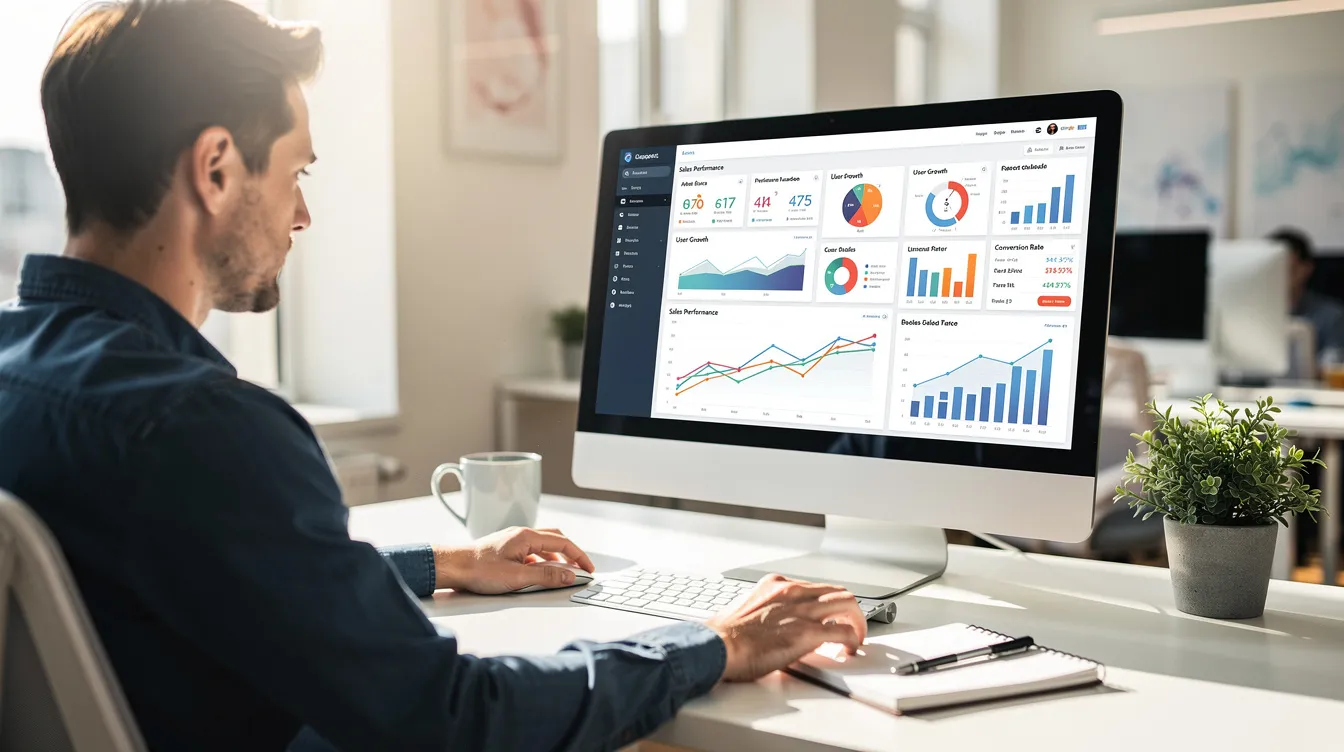
Track your site's performance: number of visitors, most viewed pages, conversion rate. The data collected through your forms can feed a CRM or a custom business tool, an area where artificial intelligence opens up new possibilities.
Long-Term Maintenance, Updates and Security
Going live is only the first step. An abandoned site quickly loses relevance, security and visibility.
Regular maintenance tasks:
- Content updates: refresh copy, products and news in step with your business
- Technical updates: security patches, system and plugin updates
- Backups: of the code and the database, so you can restore the site if something goes wrong
Periodic checks:
- Contact and payment forms working properly
- Detecting broken links
- Checking the mobile display
- Updating the legal notice and privacy policy
For companies without in-house technical resources, a maintenance and support contract with a partner such as UnzipTech makes it possible to delegate these tasks.
Why Work with UnzipTech for Your Business Website Creation?
UNZIPTECH SARL, with its office in Fès, supports small businesses, SMEs and large companies in Morocco and internationally.
Our services:
- Web development: showcase websites, e-commerce, web applications
- Mobile applications: iOS and Android, native or cross-platform
- Custom software: ERP, CRM, business tools
- Artificial intelligence: AI model integration, intelligent process automation, predictive analytics
- IT & Digital consulting: audit, digital strategy, digital transformation
- SaaS solutions
Our 4-step method:
- Listening and needs analysis: understanding your project, your target audiences and your constraints
- Design and mockup approval: mockups are approved with you before development
- Agile development with regular check-ins: you follow the project's progress
- Delivery, training and follow-up: each delivery includes training for your teams and user documentation
Each project receives a free personalized quote after analysis of your needs, with payment generally spread over several phases. Maintenance and support contracts keep your site running over the long term.
Practical Steps: How to Get Your Project Started
There is no need to wait until everything is perfect to move forward. Here is a checklist to get started:
- Define your priority goals and target audiences
- List the pages you want for your site
- Gather your logos and your photos of your team, products and premises
- Write the first key content (Home, Services, About)
- Choose a few priority keywords related to your business and your location
- Decide whether to build the site in-house or entrust its creation to a specialized partner
In short, a business website that is well designed, well optimized for search and well maintained becomes a real asset: it attracts prospects, strengthens your credibility and supports the growth of your business, in Morocco and internationally.
Ready to launch your project? Contact UnzipTech for a free personalized quote after analysis of your needs, or explore our web development services.