
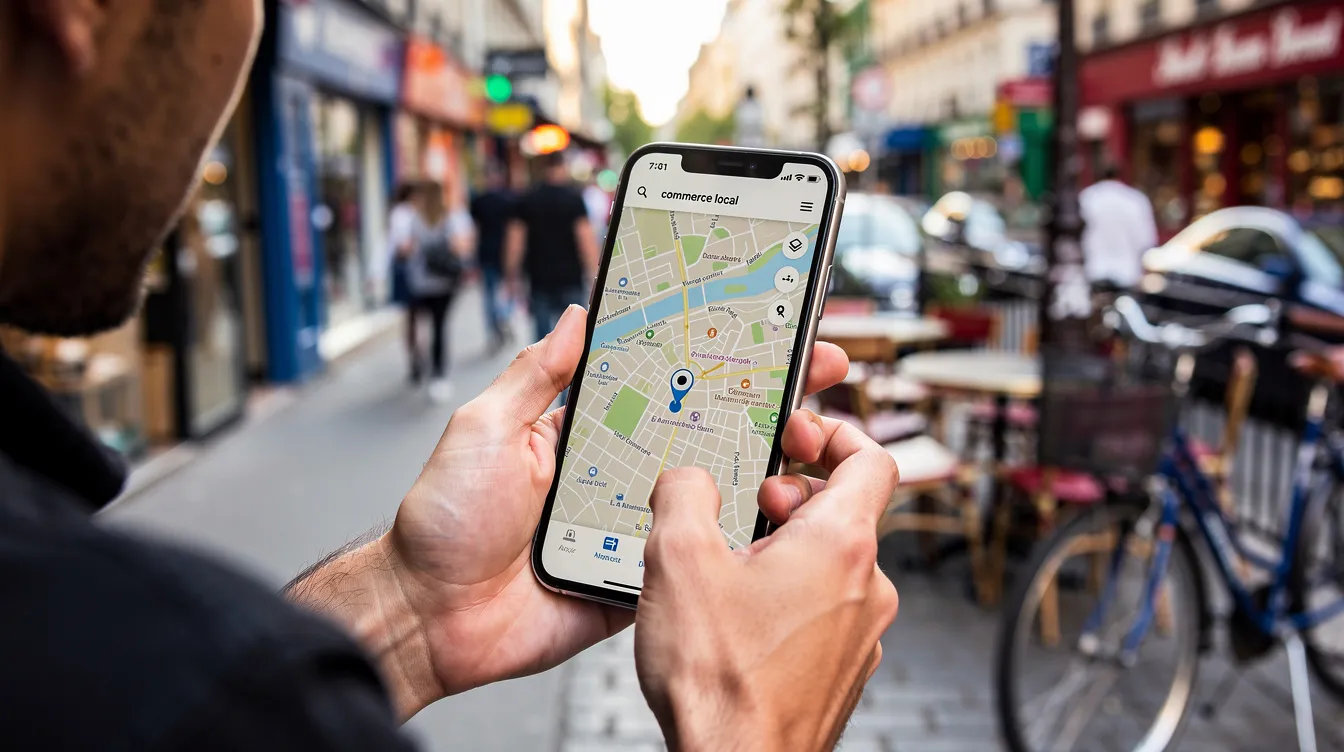
Do you run a practice, a shop, an agency or a service business in Morocco or elsewhere, and do your potential customers search for your services on Google from their city or neighbourhood? Local SEO is what makes you visible in the right place at the right time. This guide explains how Google displays local results, how to optimise your Business Profile, how to structure your website and how to build a concrete action plan, with no promise of guaranteed rankings.
What is local SEO?
Local SEO is the set of actions that help a business appear in search results when someone looks for a nearby provider: "lawyer Fez", "car rental Casablanca", "plumber near me". It concerns small and medium businesses, practices, agencies, shops and service providers whenever a geographical area defines the activity.
The difference from "national" SEO is simple: national SEO targets broad queries with no location ("online CRM software"), while local SEO targets location-based searches ("web agency Fez"). Local searches often reflect a concrete, nearby intent: calling, asking for directions, booking an appointment. Working on local visibility is therefore a useful strategy for any business that serves nearby customers, in Morocco and elsewhere.
Local SEO rests on three pillars:
- your Google Business Profile;
- a website optimised for local search (pages, content, mobile performance);
- customer reviews and consistent NAP information (Name, Address, Phone).
How Google displays local search results: Search, Google Maps and the local pack
For a local query such as "doctor Meknes" or "car rental Rabat", Google often shows a block of business listings with a map (the "local pack"), including ratings, opening hours, a website link and directions. This block usually appears before the classic organic results, which makes it especially visible on mobile.
Your Business Profile can appear in two main places:
- in Google Search: in the local pack or in a business panel (name, rating, address, hours, website link);
- on Google Maps: a pin on the map and a detailed panel when clicked.
Google also offers AI-generated answers (AI Overviews) that can summarise local options. That makes consistent information and a clear website even more important. Your goal is not just to "be on Google" but to be eligible for the local pack, Google Maps and rich answers.
The three local ranking factors: relevance, distance, prominence
Google says it mainly relies on three factors to rank local results:
- Relevance: how well your profile and website match the query. A practice that clearly states "employment lawyer in Casablanca" in its category, description and pages will be more relevant for that search than a general practice with no detail.
- Distance: how close the searcher (or the location in their query) is to the business address.
- Prominence: the business's online reputation, based notably on reviews, mentions on other websites and links (local link building, meaning links from credible local websites).
You cannot change your location, but you can work on relevance and prominence.
Key takeaways:
- choose the right category and write a precise description;
- keep your NAP strictly identical everywhere;
- collect genuine reviews and reply to them; build mentions on credible local websites.
Google Business Profile: the foundation of your local presence
Google My Business is now called Google Business Profile. This free profile feeds the local results in Google Search and Google Maps. Without a verified profile, it is hard to appear in the local pack, even with a good website.
Creating a Google Business Profile
Main steps:
- Sign in with a Google account and create or claim your business profile.
- Enter the real business name, without artificially added keywords.
- Choose the most precise primary category, then relevant secondary categories.
- Enter the exact address, or a service area if you do not receive customers on site.
- Add the phone number, website link and opening hours, including special hours for public holidays.
- Follow the verification process Google offers.
Profile optimisation mini-checklist:
- relevant categories;
- a clear description including your activity and area;
- recent, real photos (premises, team, work);
- a link to the most relevant page of your site (the location page, not only the homepage);
- up-to-date hours, including special periods;
- regular posts (news, updates);
- updating the profile whenever something changes (hours, address, phone number).
Website and local SEO: one page per location or area
Even with an optimised profile, Google relies on your website to confirm your information and understand your services. Local content should naturally mention the city and the services concerned.
Recommended structure:
- a general "About" page;
- one page per physical location (for example "Fez office", "Casablanca office");
- for businesses without premises, one page per major area actually served.
Avoid duplicate pages where only the city name changes. Prefer content specific to each place: photos, access, local team, frequent questions from the area. Use local keywords in titles, text and meta tags, without over-optimising.
Internal linking helps too: link your service pages to your city pages with explicit anchors. For the technical basics (crawling, indexing, sitemap, canonical tags), see our technical SEO guide, and to scope a new site, our guide to business website creation.
NAP consistency and local citations: a foundation of trust
Your NAP (Name, Address, Phone) must be identical on your Google profile, your website and the main directories where you appear. Contradictory information blurs the signal sent to Google and to customers.
Common inconsistencies:
- an old number still listed in a directory;
- a different spelling of the trading name;
- an abbreviated address or missing neighbourhood.
Three-step approach:
- list the platforms where your business appears (Google Maps, industry directories, social networks, booking platforms);
- correct the information to unify your NAP;
- regularly monitor changes and duplicates.
Local citations (mentions of your NAP on other websites, even without a link) contribute to prominence, but quality beats quantity. Start with the platforms your customers actually use.
Customer reviews and online reputation
Reviews appear directly on your profile: average rating, number of reviews and comments. They influence searchers' decisions and are part of the prominence signals.
A simple process:
- ask for a review after a successful job, by email or text message with a direct link to the profile;
- explain to the customer that their feedback helps others choose;
- never buy or manipulate reviews: Google's rules forbid it and the profile can be penalised.
Reply to reviews, positive and negative, professionally: thanks, explanations, an offer of direct contact if there is a problem. Reuse recurring questions from reviews to enrich your local pages (FAQ, practical information).
Review collection can be partly automated (post-service emails, CRM integration). To go further, see our guide to business process automation.
LocalBusiness structured data and mobile performance
Structured data (schema.org, in JSON-LD format) helps search engines understand the type of business, address, hours and phone number. LocalBusiness markup (or a more specific subtype) on each location page describes this information in a standard way. Other types can complement it, such as Organization for the brand or FAQPage for questions and answers.
Only mark up what is visible and accurate on the page. Any contradiction with the Google profile weakens the signal.
Mobile performance matters too: a large share of local searches happens on smartphones, and a slow or poorly adapted site drives prospects away. Test your pages (for example with PageSpeed Insights), optimise images and serve the site over HTTPS.
Unziptech designs websites built to be fast, accessible and search-friendly, using technologies such as Next.js and React.
Multiple locations: organise without duplicating
Businesses with several offices or outlets face specific risks: unharmonised profiles, different NAP from one location to another, near-identical city pages.
Good practice:
- appoint one person to validate names, addresses, hours, categories and the review process for all locations;
- create one page per location with its own content (team, access, photos, services);
- use a clear structure: an "Our offices" page, then one page per city;
- avoid multiplying "service + city" pages with no real activity.
A central back office can automatically feed the list of locations and their hours to the website to avoid discrepancies.
Measuring your local SEO
Without indicators, it is hard to know what works. The main sources:
- Google Business Profile insights: views, calls, direction requests, website clicks;
- Google Search Console: queries containing a city, neighbourhood or "near me", clicks and impressions for local pages;
- your analytics tool: traffic to local pages and conversions (forms, calls, quote requests).
Indicators to track monthly:
- calls and direction requests from the profile;
- visits to each local page;
- new reviews and average rating;
- impressions for queries that include the city;
- quote or appointment requests.
Analyse data per city or location rather than as a global average, then decide: fix a profile, strengthen a page, simplify a form. For a broader review of your tools, see our IT audit for SMEs guide.
Action plan: checklist and priorities
Starting checklist:
- ☐ Google Business Profile created or claimed, then verified
- ☐ NAP identical on the website, profile and main directories
- ☐ At least one complete local page per location or area actually served
- ☐ Process for collecting and replying to reviews in place
- ☐ Fast, readable mobile site served over HTTPS
- ☐ LocalBusiness structured data matching visible content
- ☐ Monthly indicator tracking defined
Actions by priority:
| Priority | Actions | Tools |
|---|---|---|
| 1 — Foundations | Create or claim the profile, fix the NAP, publish the main local page, check the mobile version | Google Business Profile, PageSpeed Insights |
| 2 — Structure | Add the city pages you really need, implement LocalBusiness, start collecting reviews, correct directories | Google Search Console, schema.org |
| 3 — Consolidation | Refine internal linking, enrich local content, build local mentions, adjust based on indicators | Analytics tool, dashboards |
How long it takes to see an effect depends on competition, the site's history and the volume of work: no timeframe or ranking can be guaranteed.
What Unziptech can do for you
If you lack time or technical expertise, an audit of your profile and website shows where to start and helps avoid the most common mistakes. Our advice: start with the foundations, then structure, then consolidate.
Unziptech (STE UNZIPTECH SARL) is a software engineering company based in Fez that designs, builds and maintains websites, mobile apps and business software for Moroccan and international companies. For your local SEO, we can design or redesign a website structured for local search, create location pages, implement structured data and integrate a review-collection process into your tools.
Request a free, detailed quote from Unziptech to discuss your project.
Local SEO FAQ
What is local SEO?
It is the set of actions that improve a business's visibility in a specific area (city, neighbourhood, region) on Google Search and Google Maps: business profile, website, reviews and NAP consistency.
Is a Google Business Profile enough?
No. It is essential, but website quality, reviews, local citations and mobile performance also matter.
Should I create one page per city?
Yes if you have a real presence or activity in each city. No if it produces duplicate pages without credible local content.
How long does it take to see results?
It depends on competition, the site's history and the work done. There is no guaranteed timeframe.
How do I choose a provider for local SEO?
Check that they master the Google profile, site structure, structured data and NAP consistency. Ask for a precise scope and a detailed quote, and be wary of any promise of guaranteed results.
Is local SEO useful without premises?
Yes, for businesses that travel to their customers: the profile can show a service area instead of a public address, as long as you follow Google's rules.